
Collieries Project
In 2017 the Group completed a two year project to research what ever information could be found regarding the collieries around the town. The result was a booklet for each of those researched. Each booklet contains information similar to that shown below for South Pelaw. In addition to SOUTH PELAW the following collieries were also researched and each has its own publication. PELTON FELL / EDMONDSLEY / SACRISTON / WALDRIDGE “A” and “D” / CHESTER MOOR / HANDEN HOLD / HARRATON / LAMBTON / LUMLEY / KIMBLESWORTH. The booklets can viewed at our regular Drop-In Sessions. If you require a copy then please Contact Us with details of which colliery you are interested in.
South Pelaw
Brief History
South Pelaw is an extension of Chester-le-Street and it is not certain how it got its name. However an extract from the book, “History, Topography and Directory of The County Palatine of Durham“, dated 1894 by Francis Whellan states the following:
“Pelaw, listed within Fatfield Parish, is an estate which, as early as 1360, belonged to John De Pelawe, who some years later sold it to the Elmedens, with whom it remained till the middle of the 16th century, after which it became the property of Sir Bertram Bulmer by marriage. Sir Bertram sold it in four parcels and in 1726 it was held by Francis Carr, who devised it to the Carr’s and Millbank’s. The Lambton family are now the proprietors.”
A map from 1860 shows the following named abodes all slightly north of the current Blind Lane and which would have been in the Fatfield Parish: Pelaw Farm, Pelaw House and Pelaw Cottage. If this area was Pelaw then it is fairly simple to deduce, how South Pelaw being been near to and south of this area got its name.
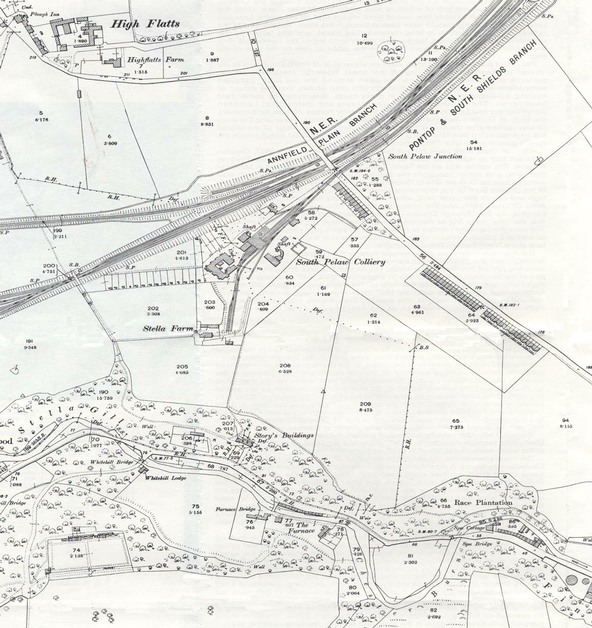
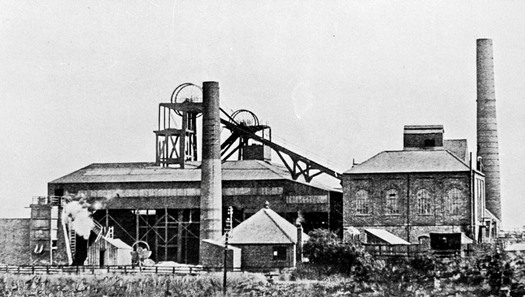
With regards to mining operations there is a reference in the book “History and Antiquities of the County Palatine of Durham 1820” by Robert Surtees which states that the Flatts, a large brick house with enclosures to the East of Pelton, was a seat of a branch of the Allan family of Grange. The Allan family can be described as one of the “incomers” to Chester-le-Street who came to exploit the coal here. The family were originally from Staffordshire and settled in County Durham in the middle of the 17th century when George Allan became established at Blackwell Grange near Darlington. His eldest son Thomas (1631-1717) acquired the Flatts near Chester-le-Street and made a fortune from combining the coal and cattle trades. One means by which Thomas Allan promoted the County was by developing and using a waggonway from Flatts Colliery to the North bank of the Wear. This was an important route, long known as “Allans Waggonway” connecting to the staiths at Fatfield and opening in about 1693. This waggonway was extended to Pelton Common by 1746.
Many years later the Perkins family started operations here in 1860, when sinking a 65 fathom shaft, later in 1890-1, a new sinking to the Busty was made, for Thomas Gilchrist; the upper level seams remained unworked. The South Pelaw Coal Company operated the pit until finally the NCB took over in 1947.
Colliery Name: South Pelaw Colliery
Location of Colliery: South Pelaw – 6 miles NNW of Durham
Number of Pits: One
Names of Pit/Pits: South Pelaw Colliery
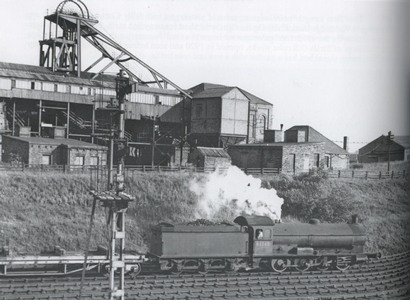
Colliery Owners
1860s Perkins & Co, 1880s E.M. Perkins & Partners
1890s South Pelaw Coal Co. Ltd., 1947 National Coal Board
Colliery Owners also owned
None
Welfare Hall
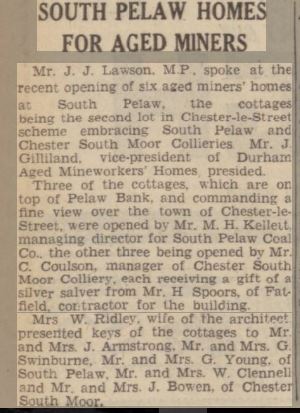
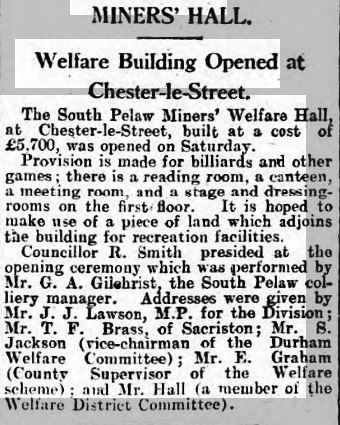
This newspaper cutting shows the Welfare Hall was opened in 1929.
Seams Worked
1914 – Busty, Harvey and Maudlin / 1930 – Busty
1950 – Busty, Five Quarter and Main / 1960 – Busty, Five Quarter and Low Main
Year Opened /Sunk
An exact date of when the colliery opened is unclear although evidence shows that operations of some sort started in 1860 but also that South Pelaw Colliery was restarted 1890 and sunk to the Busty Seam. This suggests it may have closed before 1890.
Year Closed – 1964
Output – Coal, Coking, Gas, Fireclay
Brickworks – No
Gasworks – Yes
Cokeworks – Yes at Stella Gill nearby.
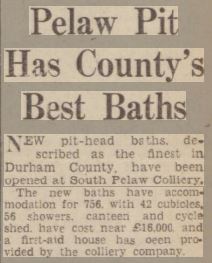
The pit baths were opened in September 1940 by Mr H. Kellett, Managing Director of South Pelaw Colliery and Chairman of Durham County Miners Welfare Committee. There were both boot greasing and cleaning rooms, and a bottle filling room.
Drift Mine – None
Places of Worship – None in South Pelaw
Drift Mine – None
Works Canteen – Yes
Numbers Employed
1896 – 353 / 1947 – 732 / 1964 – 377
Brian Cowell, who worked at South Pelaw recalled the men who worked at the pit from 1955. Please use link below for details
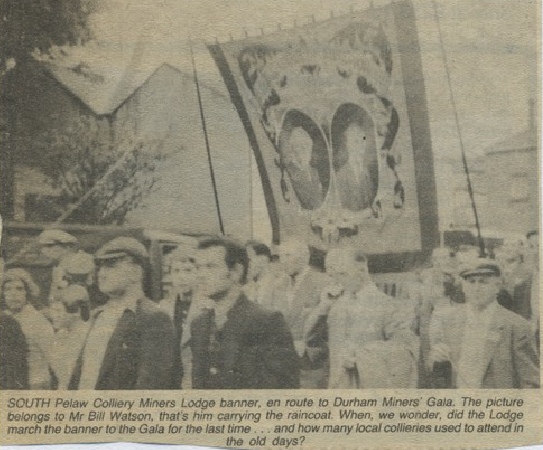
A large group with South Pelaw Miners Banner. (left)
Below some of the names are as follows:
Tommy Soulsby / Jimmy Hutchie / Ralph Sharp / Billy Storey
Noel Holyoake / George Burns / Bob Nation / Otter Nicholson
George Davison / Joe Taylor / Ronnie Baines / Dave Liddell / Josh Liddell
Tommy Pollock Junior / Tom Pollock Senior / Matt Hewitson
Stan Austin / Nichol Proud / Andy Armstrong
With kind assistance from Durham Mining Museum website we were able to create a list of fatal accidents. The youngest recorded was Edward Hurworth, who was crushed by tubs on 25 May 1864, he was only 10 Years Old.
We were lucky to find one miner who had worked at South Pelaw, and the children of another who kindly gave us their memories.